17 Container ADT II
template <typename T>
int set<T>::index_of(T e) const {
  for (size_t i = 0; i < T.size; i++) {
    if (ele[i] == e) {return i;}
  }
  return -1;
}
这里 ele[i] 和 e 的 comparisons 次数:
如果 T.size 为 n,那么 best case 是 1 次(第一个就是);worst case 是 n 次(直到最后一个才是)
这个 search algorithm 的名字就叫 linear search 或者称 sequential search,因为它的 time complexity 为 $O(n)$
17.1 Measuring the efficiency of an algorithm
- 确认 problem size: 称为 n.
比如刚才在 set 中寻找元素,n 就是 set 中的元素数量
-
选择一个 basic operation:比如
==这个比较 -
找出 function
C(n)用来表示 number of basic operations required for the problem of size n
通常我们选择 worst case. (但是更加 careful 的 algorithm analysis 中 best 和 average case也有其他用处).
$C(n)$ is constant: time complexity is in $O(1)$.
$C(n) = ax + b$: time complexity is in $O(n)$.
$C(n) = log_m n$: time complexity is in $O(log \; n)$
通过我们刚才的分析,linear search is in $O(n)$;binary search is in $O(log \; n)$.
17.1.1 binary search
Algorithm idea:
-
Look in the middle position of the array indices under consideration (err to the left if no perfect middle)
-
如果找到了:return the index;否则:Limit your search to the left or right subarray as appropriate,然后会回到 step 1.
(如果我们要找的元素不在 array 中?那么就 return -1.)
/* Requires: arr is in sorted order (least to greatest)
* size is the size of the array
* Effects: returns the index at which target appears in the
* array, or -1 if not found
*/
int binarySearch(int arr[], int size, int target) {
  int left = 0;
  int right = size - 1;
  while (left <= right) {
    int mid = (left + right) / 2; // binary split!
    if (arr[left] == target) {return mid;}  // found!
    if (arr[mid] < target) {left = mid + 1;}  // not found: move side
    else {right = mid - 1;}
  }
  return -1; // if not found: not in the array
}
binary search 的 time complexity 很明显是 $O(log \; n)$,因为我们对 2^10 = 1024 个元素只需要 10 次比较来搜索出想要的元素。
这个 binary search 有一个缺点:必须要 array 是被排序好的才可以运行,否则移动左右侧的步骤没法进行。
17.1.2 binary search 的要求: orderd set
如果我们想使用 binary search,必须要在 orderd set 上。所以原本的 unordered set 并不是理想的 data structure. 现在我们在本来的 unordered set 的基础上加一点代码,做一个 unordered set.
原本我们的 insert 只是把新元素加到最后,而现在我们通过查找这个元素按照顺序应该放的位置,并把所有该位置之后的元素后所有元素右移来实现。
这样就可以实现每次我们 insert 新元素都是 in order 的,从而 induction 下所有元素都是 in order 的。
template <typename T>
void ordered_set<T>::insert(T e) {
  if (contains(e)) return;
  assert (size < CAPACITY);
  int i = size;
  // find supposed order, at the same time
  // shifting right all elements before finding that
  while (i > 0 && e < ele[i - 1]) {
    ele[i] = ele[i - 1];
    --i;
  }
  // put in the right position (start with nothing so 0)
  ele[i] = e;
  ++size;
}
同样的逻辑,我们通过把制定元素位置之后的元素后所有元素左移来实现 remove.
template <typename T>
void ordered_set<T>::remove(T e) {
  int target = index_of(e);
  if (target == -1) {return;}
  --size;
  while (i < elts_size) {
    elts[i] = elts[i + 1];
    ++i;
  }
}
17.1.3 题外话: c++ 的 short-circuited &&
这里注意,我们可能会担心 while (i > 0 && e < elts[i - 1]) 因为 i-1 out of boundary 而出现 compiler error,但其实不用。因为 c++ 使用 short-circuited &&,意思是说当第一个 expression 为 false 时,第二个表达式将不被考虑。所以不会有 compiler error.
17.1.4 Efficiency Comparison
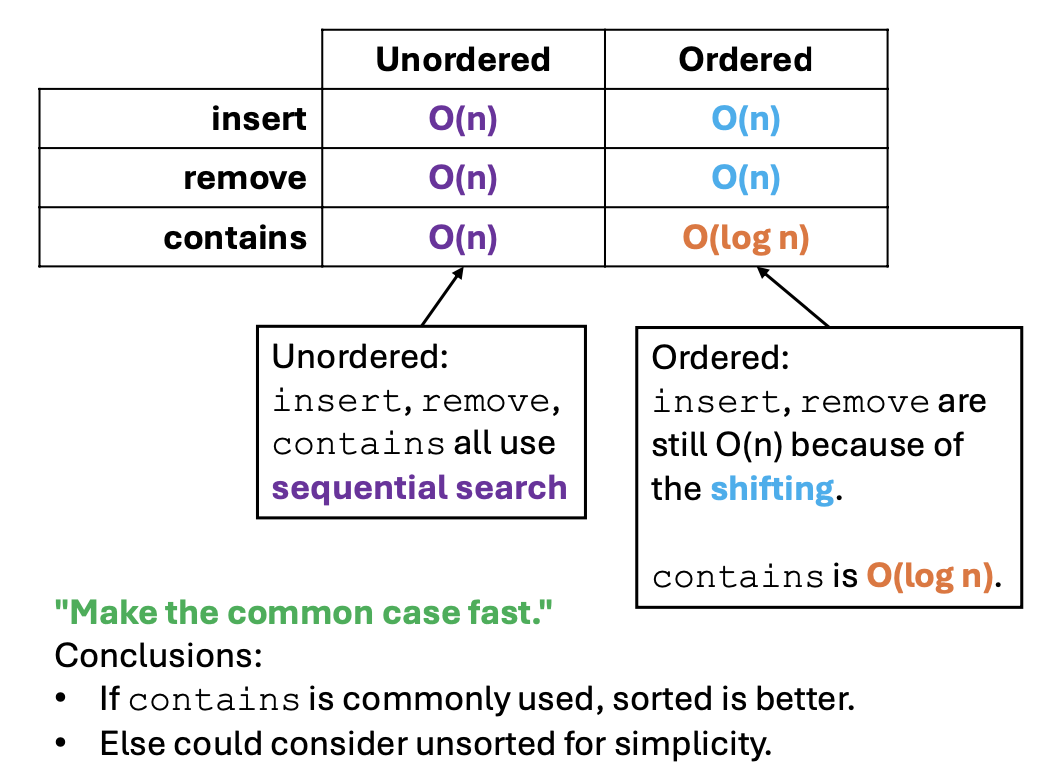
我们在 insert 和 remove 这两个 member function 中加入了一个循环,所以看起来 ordered set 的复杂度好像增加了,但其实并没有。
在 unordered set 中,我们 insert 和 remove 本身就要先使用 contain 来 linear search,$C(n) = n$,因而复杂度是 $O(n)$;ordered set 中,我们 insert 和 remove 的复杂度是 $O(log\;n) + O(n) = O(n)$. 虽然增加了一个循环使得 $C(n) = log_2 n + n$,但是复杂度(worst case)不变. 而 contain 的复杂度则大幅下降. 这在处理很大的集合时极大提高了效率。
17.2 Operator Overloading
我们在 search 中,用到了 >,== 等 comparison operator.
我们可以随便 declare ordered_set<int>, ordered_set<string> 等,但是我们发现我们如果 declare 一个 ordered_set<person>,其中 person 是另外一个 class,那么则会出现 compiler error。因为我们并没有定义 person objects 的 ==, <, > 等符号.
因而我们需要在 person 这个 class 中声明 operator<, operator== 等 functions 为friend fucntion,并在外面对这些 functions 也进行参数是 person 的overload. (也可以在 class 中作为 member functions 而不是 friend functions 来定义。)
这些 comparison operator 都是 binary operator(二元运算符),也就是说 operator function 的参数有两个,第一个是 operator 左侧的,第二个是 operator 右侧的。
class Person {
private:
  std::string name;
public:
...
  friend bool operator<(const Person &p1, const Person &p2);
  friend bool operator==(const Person &p1, const Person &p2);
};

bool operator<(const Person &p1, const Person &p2) {
  return p1.name < p2.name;
}
bool operator==(const Person &p1, const Person &p2) {
  return p1.name == p2.name;
}
我们可以发现和 return stream 的 operators 不一样的是,这些运算符就不用返回引用值了。因为不用连续运算。
17.3 main.cpp using using
我们写了两个 set class,如何简便地选择 main.cpp 使用哪一个:
选择 unordered_set:
#include "Unordered_set.hpp"
#include "Ordered_set.hpp"
//Select one implementation
template <typename T>
using Set = unordered_set<T>;

int main() {
    Set<int> is;
  //...
    Set<string> desserts;
    //...
}
选择 ordered_set:
#include "Unordered_set.hpp"
#include "Ordered_set.hpp"
//Select one implementation
template <typename T>
using Set = ordered_set<T>;

int main() {
    Set<int> is;
  //...
    Set<string> desserts;
    //...
}
17.4 其他事项
17.4.1 Static v.s. dynamic polymorphism
Subtype polymorphism 也就是 dynamic polymorphism. 发生在 run time,
Generic programming with templates 也就是 static polymorphism. 发生于 compile time.
我们在 set 的 implementation 中使用 static polymorphism 是因为 type 不在 runtime 变化.
17.4.2 check_invariant
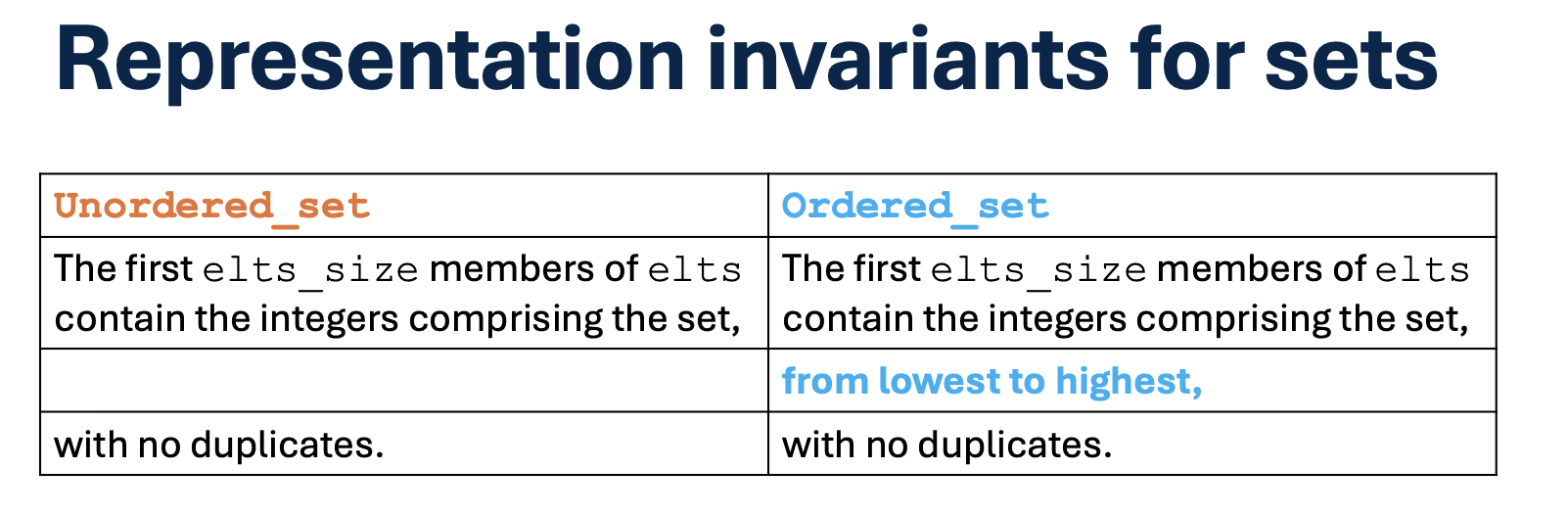
For ordered_set:
template <typename T>
bool Ordered_set<T>::check_invariant() const {
  for (int i = 0; i < elts_size - 1; ++i) {
  if (elts[i] >= elts[i+1])
    return false;
  }
  return true;
}
For unordered_set:
template <typename T>
bool Unordered_set<T>::check_invariant() {
  for (int i = 0; i < elts_size; ++i) {
    for (int j = i+1; j < elts_size; ++j) {
      if (elts[i] == elts[j])
        return false;
    }
  }
  return true;
}
我们发现不得不在 check_invariant() 中使用 nested loop. 这使得程序变得很慢. 这在testing 中是值得的, 但是在 final product 中不应该用。
我们可以在程序中禁用这些 asserts,就是碰到这些代码就忽略。方法是 compiling with the NDEBUG preprocessor.
variable defined.
有两个办法做到:
- 在 include
<cassert>之前加上NDEBUG的宏。
c++
   #define NDEBUG
   #include <cassert>
- 在 command line 写明我们包括
NDEBUG进行编译.
shell
   g++ -DNDEBUG...